Happy as a clam. A picture is worth a thousand words. Every dog has its day. A penny saved is a penny earned. What in the world do these even mean?! Unless you are familiar with these kinds of phrases, they probably sound a bit silly, probably don’t make a whole lot of sense, and might even be confusing. Sayings like these can be idioms, like we talked about last week. Sometimes, though, they are known as proverbs: short sayings meant to convey some kind of moral or life lesson.
As adults, we are likely pretty familiar with common proverbs and idioms. We hear them and say them without really thinking twice about it; we just know what they mean because we’ve known them for so long. For many of our students, however, these kinds of phrases are unfamiliar, and may sound like gibberish to them.
Just like everything else, these must be learned. We can’t expect our students to understand them and know what they mean if we don’t expose them to proverbs and other phrases. To help you with this, I’ve created a simple worksheet you can use. On it, you will find a list of the beginning half of several proverbs or idioms, followed by a blank line. After reading the first half of the saying, students can write what they think the rest of the saying is. No doubt you’ll get some funny answers, but that’s the fun of it!
** This printable is for personal or classroom use only. Do not resell, repost, or claim as your own. **
The English language can be tricky. It’s a lot of “do this” and “don’t do that”, and a lot of words that are spelled the same, but have different meanings. Or, my favorite– words that sound the same, but are spelled differently and have different meanings, and that’s just how it is, because someone a long time ago made up the rules, so you have to memorize which word to use when. And then, on top of that, we have language devices that have their own rules and uses– metaphors, similes, hyperbole, oxymorons, personification, onomatopoeia, and idioms. It’s a lot to learn, a lot to remember, and can be a lot to teach.
But… even though it can be a heavy load to learn and teach, the English language can be fun. Language devices, or figurative language, specifically can be fun. They help bring writing to life and can provide depth to writing. There are a plethora of engaging activities you can do with all grade levels to teach these concepts.
Idioms can be especially fun. Kids often find the sayings funny, so it engages them. Below is a worksheet you can use with your students. It contains a list of idioms, with a place for students to write in what they think it means. The responses students give are always entertaining, and sometimes insightful.
** This download is free, and is for personal or classroom use only. Do not sell, post, or claim as your own. **
Much of what we teach our students is taught in layers, starting with foundational skills and knowledge, then we move onto the next level of difficulty, then the next, and so on. You can’t expect a preschooler to be able to do multi step equations when they are still learning to count, nor would you assume a third grader can tell you the differences between types of cells when they don’t even know what a cell is. It just wouldn’t make sense, and would lead to frustration on all sides.
Skill building is especially important when dealing with math. Sometimes as adults, we don’t realize how much we already do know, because working through the processes and methods we’ve learned is almost automatic for our brains. We know what addition is. We know what it means to make a tally mark. We understand what a graph is and how to make one.
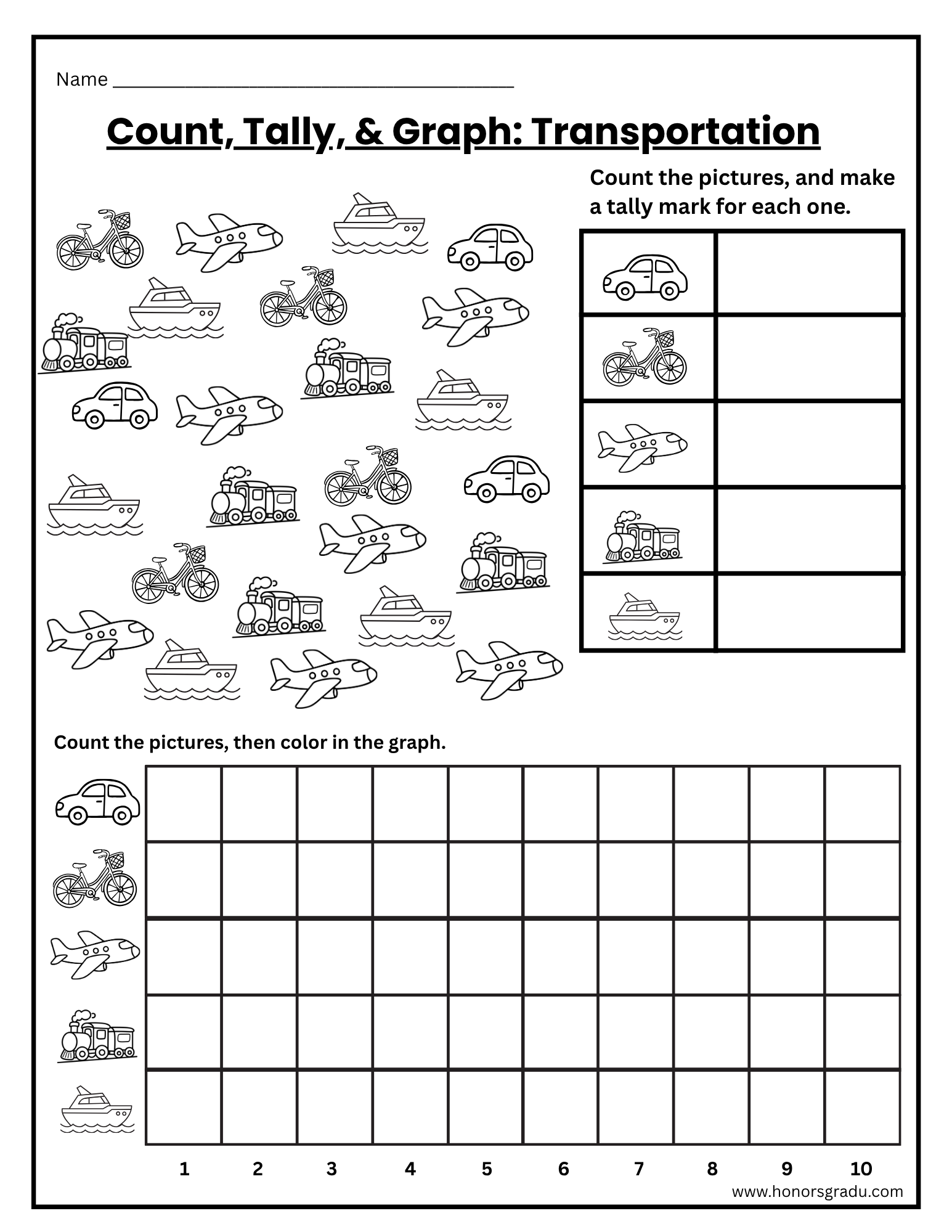
This week in preschool, my daughter learned how to count objects, tally them up, then make a graph. It is such a simple skill for my older kids (and for me), that it made me pause and realize that she’s just learning how to do those things. And you know what? That’s exciting! She’s learning new concepts and figuring out how to do things, and I love it!
So… if you teach preschool or even kindergarten, and you are working on graphing (or will be soon), I’ve got a fun worksheet you can use! Below is a download for a transportation themed Count, Tally, and Graph activity. Feel free to print it and use it in your classroom.
** This download is for classroom or personal use only. Do not sell, repost, or claim as your own. **
The world of education is anything but stagnant; it’s constantly changing, growing, improving, and moving. As we learn new techniques and methods, we adapt our teaching. When we realize some methods are outdated, we keep an open mind and try new things. As we become aware of new societal and cultural trends, expectations, and experiences, we use that information to better our teaching. This ever changing flow keeps us on our toes and helps our students receive the best possible education. Not only do we as educators change and adapt the way we present information, we also change the ways in which our students receive, process, and demonstrate their learning. While doing some research, I came across a concept I had never heard of, and was quite intrigued by: the 7 Cs in Education.
The 7 Cs concept outlines seven ways that our students can demonstrate what they have learned, and ways they can process what we teach. Each skill requires students to use a different way of gathering and processing information, thus promoting diverse thinking. The 7 Cs are as follows:
1- Critical Thinking
2- Creativity
3- Collaboration
4- Communication
5- Computer Literacy
6- Cross-cultural Understanding
7- Career and Life Skills
Each of these skills can benefit students immensely. They are relevant skills for everyday life, every subject, and are skills that they will use as they grow into adulthood. Since each skill can be discussed in greater depth, I think it would be beneficial to dive into each skill individually over the next little bit. Join me as we explore these seven areas of teaching and learning!
I’m sure you’ve heard the phrase, “Two things are certain in life: death and taxes.” And while that’s true, I would add a third certainty: stress. Everyone will, at one point or another, experience stress in their lives. The level of severity might differ, but the existence of stressors is a given.
I wish I could say that stress only happens once you’re an adult, but that’s just not the case. Kids and teens are experiencing stress early on. As adults, we have had more time to figure out how to handle the various kinds of stresses that come into our lives. But for teens and kids, managing stress can be overwhelming when they don’t have knowledge of or access to proper stress management techniques. Teachers have a unique opportunity to be able to incorporate those kinds of skills and techniques into their curriculum, thus providing the rising generation with the tools they will need to manage the stress they encounter.
You may have a few techniques that you know work, but there are always more to learn and try. Below are some stress management techniques you might consider teaching your students.
Teach students to organize and prioritize their time. Show them how to use a planner or digital task tracker. When you feel more organized, tasks feel easier to take on.
Help students to learn and practice various breathing techniques for high stress moments.
Practice mindfulness as a class, then teach them to practice it individually.
Belly breathing– this helps to redirect their focus and calm their nervous systems.
Physical activity– movement does amazing things for the brain, and is a great way to release emotional energy.
Journaling- doing a brain dump is a great way for kids to get everything out that is stressing them so they feel like they can move forward.
Art- creating art is a great stress reliever! It’s a really good creative outlet that can help students refocus.
Encourage students to get a good night’s sleep. Solid sleep has amazing benefits in so many areas.
Teach students to use the 5-4-3-2-1 method: identify 5 things they can see, 4 things they can touch, 3 things they can hear, 2 things they can smell, and 1 thing they can taste. You can practice this together as a class and have students write their answers down, then as they get comfortable with the process, they can do it on their own.
Teach your class how to do progressive muscle relaxation as a way to calm down in stressful situations.
Do regular brain breaks during class time as a way to break up the time, get students moving, and to give their minds a break from the rigors of learning.
Kids of all ages can benefit from these stress management techniques. Providing kids with proper tools can help them tremendously, and can help them turn to healthy ways to manage stress rather than unhealthy ways.
Springtime is my favorite season– the world is waking up after a cold winter, the trees blossom, and tulips and daffodils poke their sleepy heads out of the dirt. It is simply glorious! It feels like a breath of fresh air, and the sunshine brings so much joy.
Students can feel it, too. There’s a little extra excitement and happiness in the air, and it’s just so much fun! Bringing the feeling of a new season into your classroom is a great way to engage students and get them excited about learning. And as I’ve said countless times before, when fun and learning meet, magic happens.
To help you bring the magic of Spring into your classroom, I’ve created a Springtime Find & Count page you can print off and share with your class. The file includes both black and white and color versions for all printing needs.
This download is for classroom or personal use only. Do not resell, re-post, or claim as your own.
Young teacher with books and metal key on blue background
For some teenagers, reading is a struggle, and is often the last thing on their to-do list. Kids who once used to love reading have suddenly started seeing books as a burden. Perhaps this happens because of social pressure to see reading as a “nerdy” thing, or maybe they just have less time to read because of busier schedules. Another reason– perhaps the main reason– could be because they simply cannot find a book that interests them. Finding a book or a genre that pulls them in can get tricky. As teachers, we can help our students find engaging, fun to read books to hopefully spark an interest for reading.
A few weeks ago, I wrote about dystopian novels for teens. If you need suggestions for that genre, you can click here. Today, I’ll share some great historical fiction novels.
Historical fiction books are books that place fictional characters in real historical events, places, and times. This genre can be really engaging for students who are very into history. There are historical fiction novels written about nearly every big historical event, so there is something for everyone in this genre! Keep reading to learn about a few of them.
Roll of Thunder, Hear My Cry by Mildred D. Taylor
Set in Mississippi in the 1930s, Roll of Thunder follows Cassie Logan and her family, who are African-American, as they navigate segregation, racial injustices, and the Great Depression. This book does a wonderful job of painting a picture of what it would have been like for African-American families during the 1930s. Kids of any race can connect with Cassie, who is a spunky, determined little girl.
An excellent read for ages 10+
Between Shades of Gray by Ruta Sepetys
Between Shades takes place in 1941 during WWII in Lithuania and Siberia. Lina is a 15 year old girl who is taken by Soviet officers, along with her family, to a Siberian work camp. Lina is devastated when they are taken to the camp and she is separated from her father. During her time there, Lina uses her art to secretly document her experiences at the camp. This story focuses on resilience, perseverance, and survival, and teaches powerful lessons about the strength of the human spirit.
Recommended for ages 12+
Chains by Laurie Halse Anderson
Isabel is a young slave girl, along with her sister Ruth. When their owner dies, they are sold to a Loyalist couple who mistreats them. Isabel longs for freedom for herself and her sister. Hoping to secure that freedom, Isabel becomes a spy for Patriot forces, enduring horrific mistreatment. Bravery, resilience, and determination are highlighted throughout the novel as Isabel fights for her freedom. The story is powerful and moving, reminding readers that sometimes we must push ourselves beyond what is comfortable to remove the chains that bind us.
Recommended for ages 13+. Chains is the first book in the Seeds of American trilogy.
Mississippi Trial, 1955by Chris Crowe
This heart-wrenching story follows Hiram Hillburn, a 16 year old white boy who travels to Mississippi to visit his grandpa for the summer. While there, he meets a 14 year old black boy named Emmett Till, who also happens to be visiting family for the summer. Hiram and Emmett become friends as they realize they have a lot in common. Soon, Hiram discovers just how ugly racism is when Emmett is abducted and murdered. His body is found in the river a few days later. Hiram extends his stay so that he can be present for the trial and to offer any help he can in finding justice for Emmett. While this story can be hard to read because of the graphic content, it shares a powerful perspective on the events surrounding Emmett’s death. Hiram must make a decision between keeping the peace with his grandpa or standing up for what is right.
For students who are interested in this story, Getting Away With Murder by Chris Crowe is a non-fiction book that pairs really well with it.
Recommended for ages 14+
Out of the Dust by Karen Hesse
Written in poems, Out of the Dust follows Billie Jo Kelby, a young girl living in Oklahoma in the 1930s. Billie Jo must face the realities of the Dust Bowl and the Great Depression. A fire kills her mother, and leaves Billie Jo’s hands badly scarred. She must navigate the harsh realities of life during this difficult historical time all while grieving the loss of her mother, dealing with her father’s emotional battles, and learning to play the piano again after the fire. The book is set up like a journal, with each entry being a free verse poem. Teenagers can connect with Billie Jo as she navigates the difficulties of being a teenager and facing hard things.
Recommended for ages 12+
This is just a small sampling of the amazing historical fiction books that are out there, but hopefully it can provide you with some suggestions to give to a student who is needing a little help finding a book they can get into.